

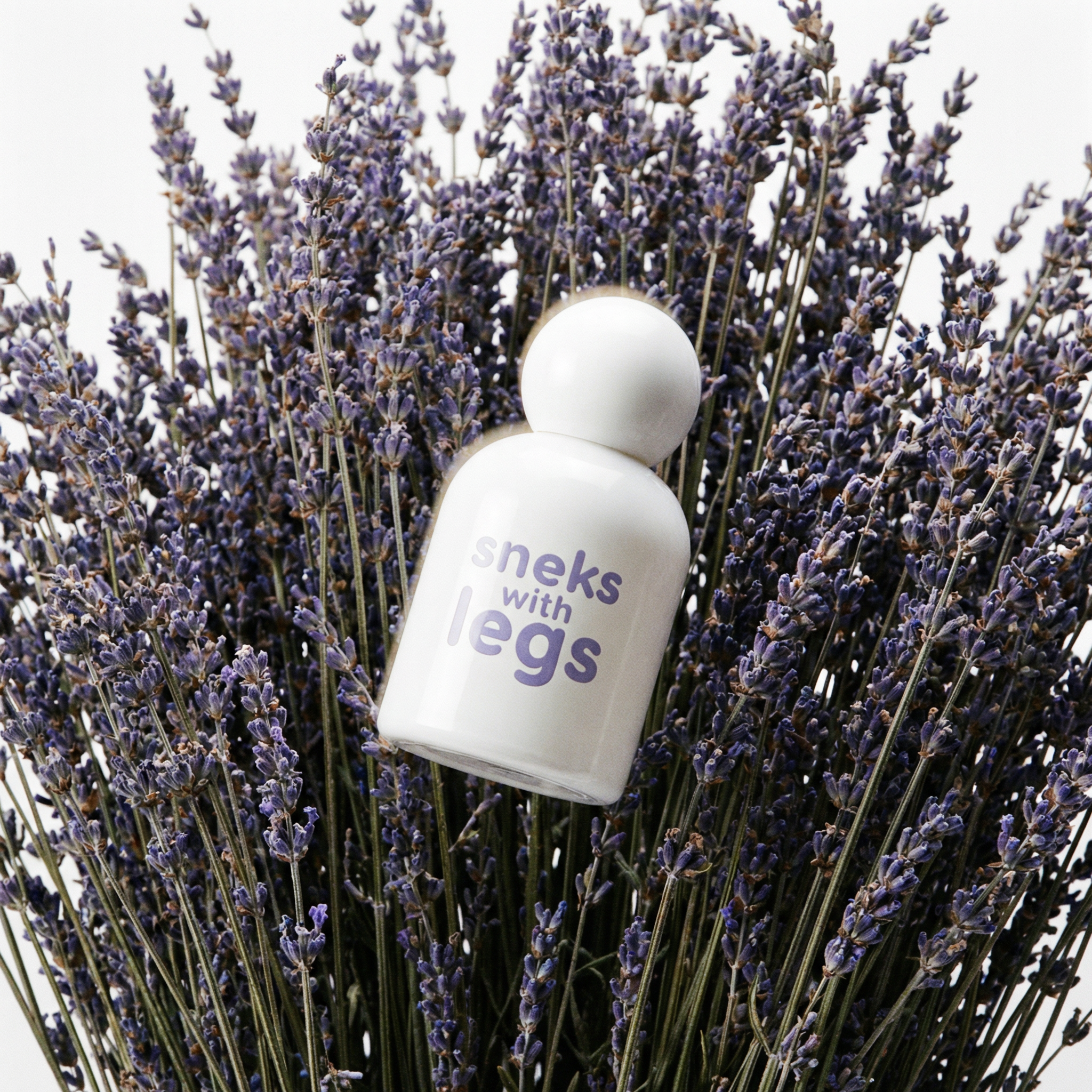
One person smells real, fresh lavender in a perfume. For another, that same lavender is associated with mothballs. For a third, with dried flowers. For one, it is the scent of peace and relaxation; for another, a reminder of cleaning day.
Who is right? Actually – everyone.
It is often exactly like that with scents. One person says: “fresh, natural, wonderful,” while another grimaces and replies: “but it smells like detergent.” The same scent. The same moment. Two completely different reactions.
And no, it doesn't necessarily mean someone has “better taste,” a “worse nose,” knows less, or has a more refined opinion. Scent is not something we perceive entirely objectively. It is not a photo that everyone sees the same way. Scent is an interpretation. And that interpretation passes through our body, memory, emotions, experiences, and everything we have ever encountered before.
Is scent perception just a matter of taste?
Of course, taste exists and matters, but it doesn't explain everything. Some prefer fresh scents, others heavy ones. Someone loves white flowers, while someone else cannot stand smelling them for more than two minutes. One person looks for cleanliness in perfume, another for something strange or unsettling.
And that is absolutely normal.
If everyone liked the exact same scents, the world of perfume would be terribly boring. There would be no room for experiments, personal obsessions, little quirks, and moments where someone says: “I don't know why, but this scent is mine.”
But taste is only the first level. It tells us if we like something, but it mainly refers to our own perception. It doesn't always explain why the same perfume smells fresh and natural to one person, but suffocating and artificial to another.
Scent is not just about a simple choice: I like it or I don’t. Sometimes we react not to the composition itself, but to the story our brain immediately writes for it. To a memory or an association. To something we used to smell often, even if today we can no longer say exactly where and when.
That is why two people can have completely different reactions to the same perfume – and neither of them has to be wrong.
Every nose works a little differently
Before a scent becomes a memory, an emotion, or an opinion like “I love it” or “I hate it,” something much more basic must happen. Scent molecules enter the nose and stimulate olfactory receptors. It sounds simple, but it isn't quite that straightforward.
We do not have identical “equipment” for perceiving smells. Olfactory receptors can vary between people, which is why two people do not always perceive the same perfume in the same way. One person will immediately pick up a green note that another won't even notice. Someone will primarily smell vanilla, while another will say: “what vanilla? I only smell powder.”
The nature of perfume itself doesn't make it any easier. Perfume is not one simple molecule. Even single-note perfumes are complex compositions of many aromatic substances that together create something greater than the sum of their individual ingredients. When we smell them, the brain usually doesn't break them down into a full list of elements: vanilla, musk, wood, aldehydes, amber. More often, it glues them together into a whole – a general impression. It is only from this whole that individual notes stand out. Usually those to which we are more sensitive, those we know well, or those we strongly associate with something.
A professional perfumer or a trained individual may recognize more nuances than someone who simply uses perfume for pleasure. They have a larger scent “vocabulary,” more experience, and better-trained attention. But even an expert does not perceive a complex perfume as a full list of all molecules, one after another. Training helps to better recognize and name scents, but it doesn't change the fact that a mixture is often perceived as a fused whole.
This is why conversations about perfume sometimes sound as if everyone is talking about a different scent. And in a sense, they are. We can perceive some molecules very strongly and others more weakly. We are sensitive to some, while others may be almost imperceptible to some people. So it's not just that someone “can't” smell something or is “describing it wrong.” Sometimes the nose truly picks up a different part of the same composition.
And that is just the beginning, because a scent does not end in the nose. Later, skin, temperature, emotions, memory, and the entire private dictionary of associations we carry in our heads come into play.
Scent is not just the nose – the brain has a say too
The nose picks up scent molecules, but it is the brain that tries to make sense of them. It doesn't just ask: “what substance is this?”. It asks rather: “what do I know this from?”, “was it pleasant?”, “is it safe?”, “do I want to be closer to this scent or move away from it?”. That is why a scent very quickly stops being neutral information. It becomes an association.
The same clean note can smell fresh to one person, like laundry dried in the sun, and artificial or chemical to another, like laundry detergent. This is one of the reasons why the word “chemical” can be so difficult in conversations about perfume. Sometimes someone truly smells something sharp, synthetic, or unnatural. But sometimes “chemical” simply means: my brain has linked this scent with detergent, floor cleaner, air freshener, or a cosmetic I have known for years.
A good example is the fresh, aquatic scents of the 90s and 2000s, which for many were once a symbol of purity, elegance, and freshness. Later, similar accords began to appear in shower gels, deodorants, laundry detergents, and cleaning products. The result? One person smells freshness and nostalgia. The other says: “this smells like a bathroom.” This doesn't mean the scent itself has become worse. It simply means the context in which we encountered it has changed.
Sometimes associations are quite simple. A scent reminds us of laundry powder, a childhood cream, a school hallway, or a vacation sun lotion. Other times, it works much more powerfully. A single scent can suddenly evoke a very specific memory – a place, a person, or a situation we haven't thought about in a long time.
This phenomenon is called the Proust effect. Scents are exceptionally strongly connected to autobiographical memory and emotions, which is why they can return to us not as dry information, but as an entire feeling: peace, longing, safety, warmth, or nostalgia.
At Söppö, we often talk about perfumes as memory capsules. Not because everyone has to feel the exact same thing in them. Rather, because a scent can touch something very personal, even if we can't name it at first.
How does the brain know what to link a scent with?
Our olfactory associations don't come from nowhere. We learn them throughout our lives – most often completely unconsciously.
If a certain scent appears in a specific context for years, the brain starts to link one with the other. Not because someone told it: “this is the smell of cleanliness,” “this is the smell of home,” “this is the smell of vacation.” Rather, because it smelled it many times in similar situations.
This is how a private dictionary of scents is built.
For one person, citrus can be freshness, lemonade, and orange peel being peeled at the kitchen table. For another – dish soap. For one person, coconut can be vacations, warm skin, and after-sun lotion. For another, something suffocating, cheap, or too sweet. Someone will smell elegance in powdery notes, while someone else will smell their mother's beautician or the locker room after PE class.
And that is exactly why scents are so hard to standardize. We don't learn them from a single, shared manual. We learn them from apartments, bathrooms, schools, vacations, people, cosmetics, detergents, shops, travels, and all the small places where our lives actually happened.
Over time, the association can become stronger than the note itself. Then we no longer just smell “citrus,” “lavender,” or “musk.” We smell what our brain has learned to link them with.
Will a perfume review tell you if it's the scent for you?
This is why perfume reviews are great inspiration, but they shouldn't be a final verdict. They can suggest the direction of a scent, its vibe, and first associations. Whether the composition leans more toward sweetness, freshness, powder, fruit, cleanliness, creaminess, or something more strange and non-obvious. But it is still part of a very subjective perception of scent. When someone writes that a scent is “chemical,” “artificial,” “wonderful,” “realistic,” “enveloping,” or “clean,” they are telling the truth about their perception. It’s just that this perception has passed through their nose, memory, experiences, mood, and private dictionary of associations.
There are also things that seem more objective: longevity, projection, sillage, scent trail, intensity. Reviews can be very helpful here, especially if many people say the same thing. But even these parameters are not entirely detached from the person testing the scent. How long and how strongly a perfume smells can be influenced by the skin, its hydration level, sebum amount, pH, body temperature, microbiome, and even the conditions in which the scent was tested: weather, humidity, season, clothing, the number of sprays, or whether the perfume was checked on a blotter or on the skin, in autumn or summer, in a humid or dry room, on a sunny or windy day.
That is why one person can smell a scent all day, while another, after a few hours, feels as if it has almost disappeared. On one person, the perfume may be soft and close to the skin; on another, sharper, louder, or drier. This doesn't always mean someone is exaggerating. Often, it simply means the scent behaved differently in a different context.
Reviews can be a map, but they are not the journey itself. Therefore, it's best to treat them as an invitation to try a scent, rather than the final answer. Because only your skin, your nose, your memories, and your private dictionary of associations will show what that scent will become for you.
We will talk more about whether perfume reviews really help you choose a scent in a separate post.
Can a scent “change”?
Sometimes we get the impression that a scent has changed. It used to smell fresh and natural, and today it suddenly seems more artificial. It used to be soft and pleasant, and now it irritates. We used to not notice any specific note in it, and over time we start picking up something we didn't see at all before.
And sometimes a scent really can behave differently – for example, on different skin, in different weather, a few hours after application, or when the lighter ingredients evaporate and the heavier ones remain.
But very often, it is not the scent itself that changes, but our interpretation.
The scent molecules may be the same, but the way we perceive them can shift over time. If a similar aroma appears in new contexts over the years, the brain starts to assign it new meanings. A scent that was once associated with elegance may begin to remind you of a cosmetic, detergent, or a specific product you encountered often later on. This doesn't have to be a “spoiling” of the scent. Sometimes it is simply a change in the story we have written around it.
Our mood and the moment we smell the perfume also matter. We perceive scent differently when we are calm than when we are tired, overstimulated, or having a bad day. The same scent can seem soothing one time and too intense another. Nostalgic one time and overwhelming another.
Our nose also changes. The more we smell, compare, and learn about scents, the easier it becomes to recognize specific notes. Something that was once just “nice and creamy” may, over time, become clearer to us: vanilla, musk, powder, almond, milkiness, wood. Sometimes we get to know a molecule or an accord and suddenly start sensing it everywhere. Not because it wasn't there before. Simply because we didn't have a name for it yet.
That is why a scent can change for us, even if it remains the same in the bottle.
It isn't always the perfume that is different. Sometimes it is us who are different – with new experience, a new association, a different day, and a slightly more sensitive nose.
A short truth to finish
There is no single, objective way to perceive scent. Each of us experiences it through our own body, nose, memory, emotions, experiences, and associations gathered throughout our lives. That is why two people can smell the same perfume and say something completely different about it. One: “fresh, natural, beautiful.” The other: “sharp, artificial, not for me.” And both reactions can be true.
That is exactly what is most interesting about perfume.
That’s why it’s worth listening to reviews, opinions, and descriptions, but in the end, it’s best to return to yourself. If a scent is beautiful, moving, pleasant, or simply yours – that is enough. It doesn't have to be that way for everyone. And vice versa: if something that others love smells too sharp, too artificial, or simply unpleasant to you, that is also okay. It doesn't mean you don't know your stuff. It means your nose is telling a different story.
So maybe sometimes it’s not the scent that’s the problem – but the story we carry within it.